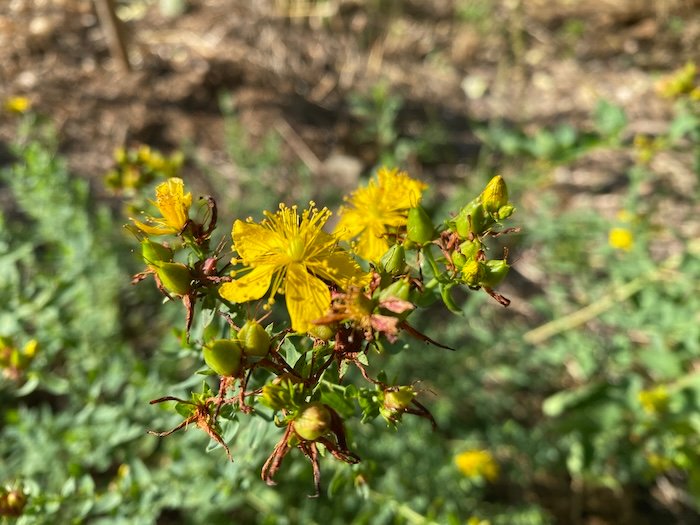
One of my favorite flowering herbs. I macerate it in oil to obtain “red oil”, which is useful as a rub for lumbago, gout, rheumatism, to relieve pain of sprains, heal wounds, for bruises and light burns. The red color comes from
Please note: Hypericum perforatum is toxic for sheep, cows and horses. And before it is consumed internally (i.e. for depression) or used externally, one should consult with one’s physician since it can cause adverse effects or pharmacological interactions when used with other drugs.
In the spring 2023 I planted some seedlings obtained from Swiss seeds – and almost all of them thrived here. Which is not really surprising since Hypericum perforatum is one of the most widely distributed varieties of Hypericum, growing from Europe to China, in Western North Africa and Sudan. In America and Australia it is considered an invasive and toxic neophyte.
Hypericum perforatum is a robust herb, preferring half shade and temperate climates, but it grows and flowers here, albeit only from May through June/July, before it dries up completely until the next year.
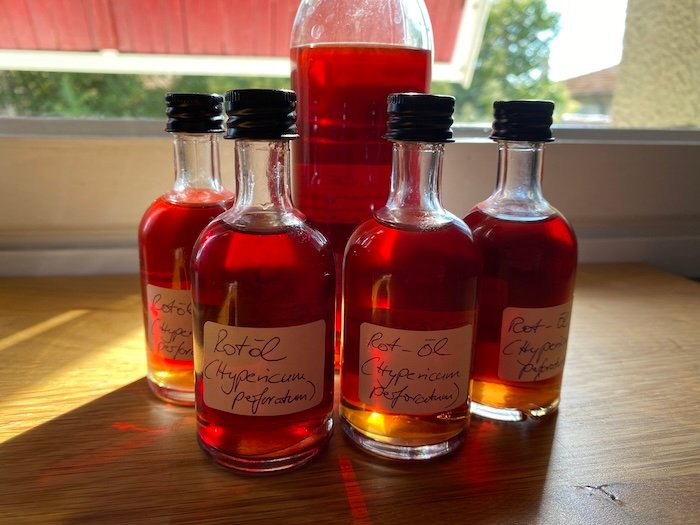
“Red Oil” – St. John’s Oil – Hypericum Oil
“Red oil” is an herbal extract from Hypericum perforatum (St. John’s wort). It is a warming oil for muscle pain, tension, sprains, rheumatism, but also for wound healing in cases of minor burns or skin irritation.
It’s easy to make: just cut off the tops with the yellow flowers, put them in jars, cover with good (olive) oil and put them near a window for some weeks until the oil turns red. The longer the better in my experience. Then filter through some kitchen paper and keep in a cool, dark place.
The flowers need to be the „perforatum“ type though – recognizable by the small dark flecks on the flowers or the red color stains on your fingers when squeezing flowers.
Leave a Reply