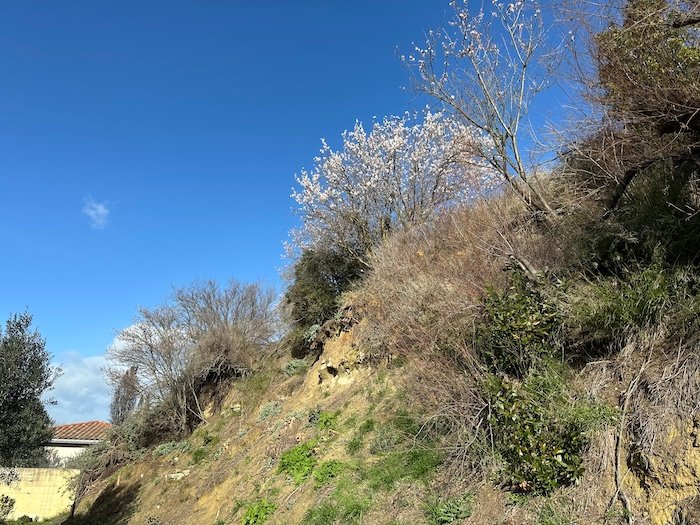
Monoxia obesula came back again last spring and by the summer all the huge old Atriplex halumis bushes were a mess of grey-white dried up leaves, accumulating in dirty-looking heaps around the foot of the plants after each rain. A very ugly sight and a big fire hazard as well. So we had all the rest of the Atriplex shrubs cut back to the stump in the fall and did extensive replantings with alternative plants.
Some of the plants that we had tried out the year before to retain soil with their roots had not really worked out. Of the 30+ vetiver grasses planted in the late winter 2025 only two or three survived the summer – despite some very good spring rains. Baccharis pilularis (Coyote brush) sadly also did not survive the summer.
This time we planted a variety of drought-tolerant plants that don’t need a lot of maintenance to hopefully take the place of the Atriplex halumis shrubs:
- Tamarix gallica
- Arbutus unedo
- Pistacia lentiscus
- Rhamnus alaternus
- Phillyrea angustifolia
- Bupleurum fruticosum
- various high- and low-growing Cistus
- various Phlomis
- Ballota pseudodictamnus/acetabulosa
- Centaurea argentea
- Convolvulus oleifolius
- Salvia Bee’s Bliss
- Limoniastrum monopetalum
- Grasses like Ampelodesmos mauretanicus, Piptatherum miliaceum, Brachypodium phoenicoides, Stipa tenacissima
- Seeding plants like Foeniculum vulgare and Asphodelus fistulosus
- Carpobrotus, Sedum, Drosanthemum, etc.
- etc.
Criteria for the selection was high drought- and heat tolerance, deep root systems, rapid growth, persistant foliage, and allelopathic properties to keep down weeds.
We had planned to have the gardener put in wooden rails in January to shore up the plants on the steeper parts so we could effectively water in the summer. But then winter came and with it totally unheard of water volumes. Between December 2025 and February 2026 it rained as much as in all of 2024 and two thirds of the total rain amounts of 2025.
Hearing the rain come down in buckets over endless hours it was hard to imagine that the whole slope didn’t just wash away but one of the benefits or our alcaline soil is that it’s quite sticky when wet and can be pressed back down where it threatens to lift off. Even so the bare parts of the slope got even barer and we really hope to get most of it revegetalized as soon as possible.
Leave a Reply